Understanding Your Daily Horoscope
Learn how daily horoscopes are interpreted in Western astrology, what they can and can’t do, and how to use them as a grounded reflection tool.
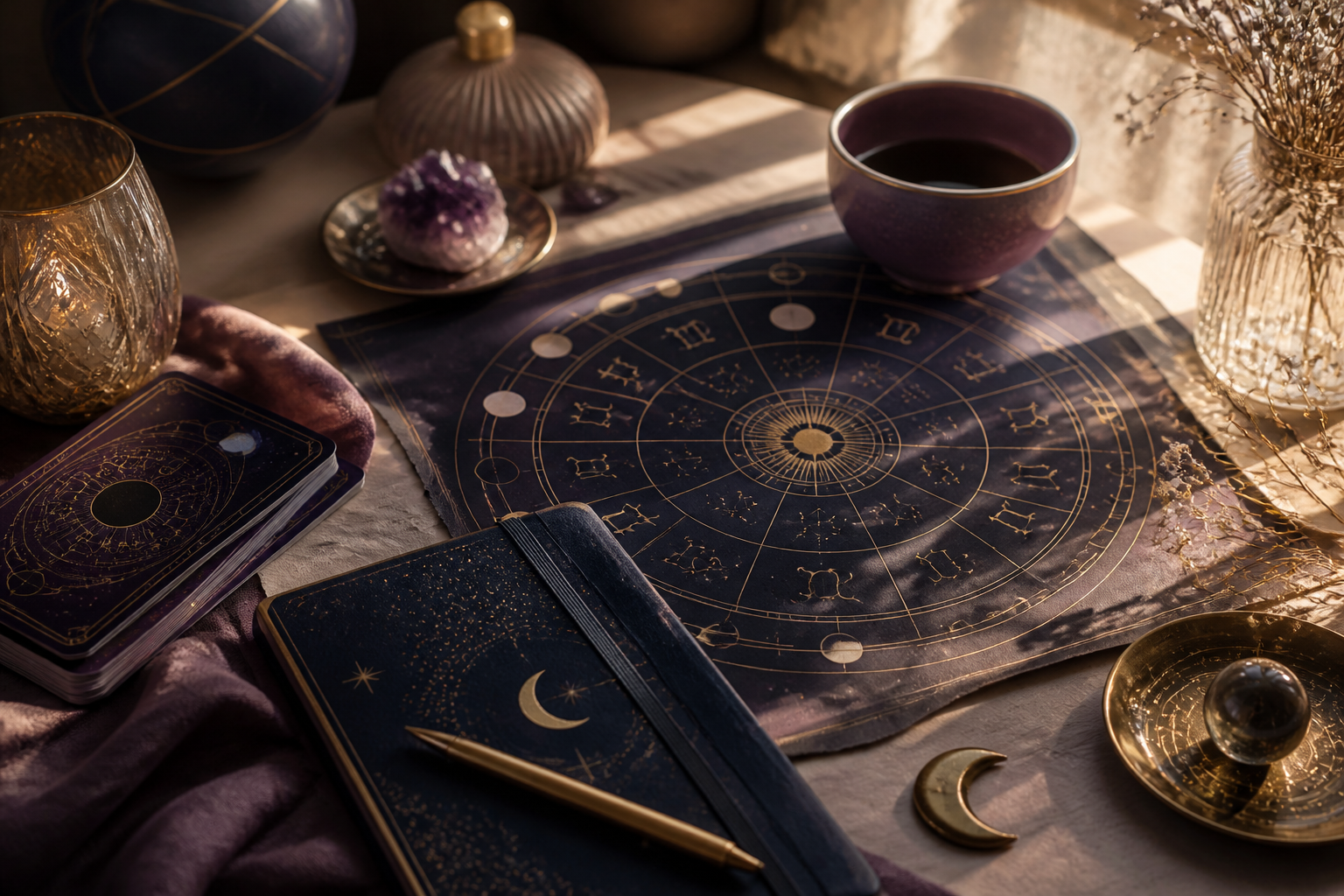
What is a daily horoscope meant to do?
In Western astrology, a daily horoscope is an interpretive message that links current planetary symbolism with a zodiac sign or chart placement. It is usually written to suggest a mood, priority, or area of attention rather than to promise a fixed event. The important distinction is that the horoscope translates symbols into practical language; it does not claim that planets force choices or outcomes.
That is why horoscopes are often useful even when they stay broad. A reading might point toward patience, clearer communication, or better pacing, while still leaving room for your own judgment. Two people with the same sign can take the same message in very different directions because their circumstances are different. In that sense, a daily horoscope works best as a prompt for reflection, not as a script you must follow.
How do astrologers turn the sky into a short reading?
Traditional horoscope writing begins with symbols such as planets, signs, houses, and aspects, then narrows them into a concise message. In Western astrology, Mercury is often associated with thinking, messages, and schedules, while the Moon is commonly read as shifting feeling and immediate needs. An astrologer might see a challenging aspect between those symbols and interpret it as a day for slower replies or clearer planning.
That process is still creative, not mechanical. The same sky pattern could also be read as a chance to organize scattered ideas or repair a misunderstanding. A daily horoscope is therefore a curated lens, shaped by the writer’s judgment and the audience’s likely concerns. For example, one astrologer may emphasize caution, while another highlights adaptability. Both readings can be coherent even if they sound different.
What does a horoscope look like when applied to real life?
A practical example helps make the symbolism concrete. Suppose a horoscope for Libra says, “A conversation may require extra tact today, so choose your words carefully.” In astrological tradition, Libra is often associated with balance, fairness, and relationship awareness, but that does not mean every Libra reader will face conflict. The message is better understood as an invitation to pause before reacting.
A contrasting case matters too. Someone with strong Libra placements may be blunt, quick-deciding, or not especially diplomatic. In that situation, the same horoscope might not describe personality at all; it may simply suggest slowing down before making a social commitment. The useful question is not “Is this literally true?” but “Where in my day could more clarity or fairness help?” That keeps the reading personal without turning it into a stereotype.
Why can the same horoscope feel accurate one day and off the next?
Daily horoscopes work with broad symbolism, so they naturally vary in how closely they match a reader’s experience. One day the message may seem uncannily timely; another day it may feel vague or irrelevant. In astrological interpretation, that does not automatically mean the reading failed. It may simply mean the theme is subtle, indirect, or not the most active issue in your life.
There are also limits built into the format. A sun-sign horoscope cannot account for every time zone, life stage, or personal chart detail. It may capture a general mood rather than a specific event. Some readers appreciate that openness because it leaves space for intuition; others prefer something more precise. A balanced approach is to treat the horoscope as one viewpoint among several, not as a final verdict on the day.
How can you use a horoscope without taking it literally?
A grounded way to read a horoscope is to test the symbolism against ordinary life. If the message emphasizes caution in communication, look at whether an email, family conversation, or work message needs extra care. If it highlights momentum, notice where you have been hesitating too long. In both cases, the value comes from translating imagery into a small, observable action.
One simple planning method is:
- Identify the main theme, such as rest, honesty, patience, or momentum.
- Match it to one situation you will actually encounter today.
- Choose one modest behavior that fits the theme.
For example, a horoscope about “steady progress” could become: answer the most important message first, then move to lower-priority tasks. That keeps the reading practical without pretending it can predict every detail of the day.
When should practical judgment matter more than astrology?
A horoscope can be meaningful and still not be the right tool for every decision. If you are dealing with a legal problem, a health concern, a financial emergency, or a relationship situation involving safety, practical information and qualified support matter more than symbolic interpretation. In Western astrology, the reading may offer a reflective frame, but it should not replace evidence-based advice or direct action.
This is especially important in relationships. A horoscope should never be used to excuse manipulation, pressure, or unsafe behavior, and it should not be used to keep someone in a harmful situation. If a reading feels unhelpful, you can simply set it aside. In some cases, the most responsible response is to seek outside help and make decisions based on facts, not symbolism.
How can reflection make a daily horoscope more useful?
For readers who want a more contemplative approach, a daily horoscope can function like a mirror rather than a forecast. In reflective traditions, meaning often emerges through attention, comparison, and self-observation. If you want broader context, a more specific resource on [reflective spiritual guidance](/categories/spirituality) may help show how symbolic practices are used for awareness rather than certainty.
A brief reflection exercise can make the reading more honest: after reading the horoscope, write down one detail that fits your day and one that does not. The contrast matters. Maybe the message correctly names your mood but misses the situation, or maybe it points to a concern you had not noticed yet. Either way, you are using the horoscope as a tool for awareness, not as proof that one interpretation is the only one.
Conclusion
Daily horoscopes are most useful when they are treated as symbolic interpretations, not fixed predictions. In Western astrology, they offer a compact language for noticing patterns, setting an intention, or reconsidering a choice. Their strength is not certainty but flexibility: a good reading can prompt reflection without overruling your judgment. If a horoscope helps you think more clearly about your day, it has served a purpose. If it does not fit, you can leave it aside and rely on other forms of insight.
About the Author
Awelax Editorial Team
The Awelax Editorial Team creates educational content about psychic readings, intuition, relationships, tarot, and spiritual topics, with an emphasis on responsible guidance and clear expectations.
Learn about our editorial process →Need Personal Guidance?
Your situation is personal. Your reading can be too.
Connect with a live Awelax psychic advisor for private guidance about love, relationships, career, spirituality, and life's important questions.
Find a PsychicAwelax provides psychic and spiritual guidance for entertainment and personal insight. Readings are not a substitute for professional medical, legal, financial, or mental health advice.